
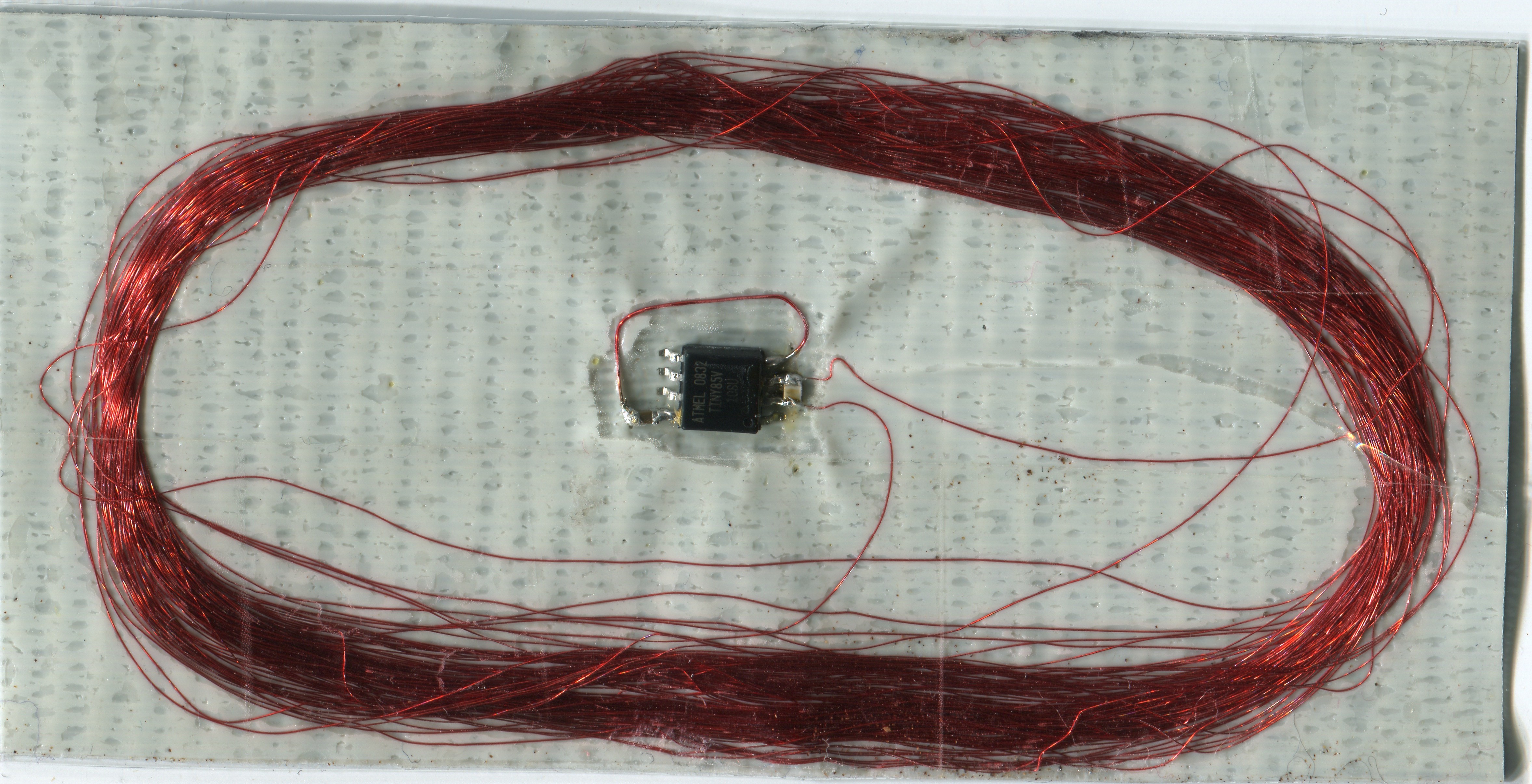
Duct tape RFID tag #1

This is just a messy first prototype, but I recently tried making an AVRFID tag on a substrate of duct tape. The first attempt involved:

  • An upside-down strip of duct tape, as the base for everything else to stick atop
  • 100 turns of AWG 40 magnet wire around a ~66mm diameter form, which I then haphazardly squished against the tape
  • An ATtiny85 µC in the SOIC-8 package, programmed with the latest AVRFID firmware
  • SMT 0.1 µF capacitor across the power pins
  • SMT 1 nF capacitor in parallel with the coil, for tuning it to approximately 125 kHz
  • Sealed with clear packing tape on the opposite side

It’s ugly, and I really want to try this experiment over again with a smaller IC package, like TSSOP-8. But the card works very well, and the read range is practically indistinguishable from a mass-produced RFID card. I tested this one using an official HID ProxPoint reader.

I’ve been busy, but once I have time to perfect this technique I’m hoping to write some instructions, as it’s a pretty quick and easy way to make a DIY RFID tag that’s actually in a convenient form-factor.

Comments
32 Responses to “Duct tape RFID tag #1”
  1. Tim says:

    How can I use this on an ATTiny13v? The ATTiny85 and the ATTiny13 seem to be pin compatible.

    • Beth says:

      Unfortunately the ATtiny13 doesn’t have enough program memory.. the current AVRFID implementation is pretty memory hungry.

      • David M. says:

        I’ve been trying to compile your code for the ATMega168 target, it compiles fine for EM4102, but fails on HID with this error:

        avr-gcc -Wl,-Map,avrrfid.map -mmcu=atmega168 -o”avrrfid.elf” ./avrfid.o
        ./avrfid.o: In function `loop’:
        (.text+0x1d12): relocation truncated to fit: R_AVR_13_PCREL against `no symbol’

        I discovered that if I comment out these two lines, it compiles ok. Im confused how it could be a memory issue, since the Mega168 should have plenty more than the Tiny85.

        manchester HID_SITE_CODE, 8
        manchester HID_UNIQUE_ID, 16

        regards
        David

        • David M. says:

          Ok I think I figured it out. Changing “rjmp loop” to “jmp loop” makes the code compile for ATMega168.

          I’ll report back once I can see if the code still actually works or not. Ill be making one for the ATTiny85 using the original code as well, just as a control.

          -David

      • Martin says:

        What about using an ATMEGA8515?
        Or do you think, I’ll get problems with the required power?

  2. Anthony Potts says:

    What sort of reading range do you get from this?

    • Beth says:

      I didn’t measure, but it was a few inches, and close enough to the range of an official HID-manufactured card that I didn’t notice a difference.

  3. Jeff V says:

    I was thinking of playing with RFID in the future, and this post and other like it are quite educational for me. Thanks for posting!

  4. jukus says:

    A truly elegant hack. Please find the time to document the build :)

  5. spidersinthewalls says:

    hmm. could this be used to duplicate a rfid card? i wanted to build a tag database using as few entries as possible, but for it to work i would need multiple rfid cards with the same id code- something that the wholesale rfid card companies dont want to do.

  6. feuerrot says:

    Is it possible to bruteforce a simple RFID door lock system with a few changes at the code? My school here in germany is using the 125kHz-RFIDs for the door of our library and they want 5€ (~7US$) for the card.
    C code wouldn’t be a problem, but I’m not into assembler so much, that I understand it.

    • Peter Zich says:

      I believe most of these systems lock out for a little while after many failed attempts to prevent exactly that. It’d probably be easier to clone a friend’s card.

  7. Christian says:

    If I used a larger AVR chip, would this still work assuming I provided external power?

    • Beth says:

      Yes, it should work with external power, like say a lithium coin cell. I haven’t tried this myself- if you do, please write about it! Also, just because the chip is bigger, I wouldn’t necessarily assume it needs external power. Try it without, see if it still works :)

      Since this whole concept uses the chip very much out-of-spec, my best advice is to experiment.

  8. Jay says:

    How is the uC powered? It seems like the Vcc & GND pins are just linked together with a capacitor, but how is power provided?

    Thanks in advance.

  9. Beth says:

    This is explained by the original AVRFID page- it’s powered by the AC from the coil, which is rectified by the chip’s I/O clamping diodes.

  10. Chris says:

    I have peeled off an anti-theft 1.5inch x 1.5inch RFID tag from a book that was bought from a book store. Does anyone know whether there is a possibility that an HID ProxPoint reader will be able to read that anti-theft RFID tag? Or does the HID ProxPoint reader run on totally different systems? My tag from the book looks something like this: http://cdn3.explainthatstuff.com/rfid.jpg

    Thanks,
    Chris

  11. Peter Zich says:

    Hello Beth,

    First, thanks for the great article. This sounds awesome and I’m ordering supplies now.

    I was wondering if there was a similar article about reading HID cards? I have an RFID reader on a PCB but it seems to be limited to only its RFID cards. I’ve examined the HID cards I have and they seem to be using some sort of translation table for the ID cards (like the 5 digit ID card and 10 digit sales order number in http://www.hidglobal.com/documents/125khz_htog_en.pdf ) instead of the actual site code or unique ID.

    Thanks for the help,
    Peter

  12. Could this be ported to the PIC 10F200? Or even the 10F206 would be feasible as the main difference is more memory.

Trackbacks
Check out what others are saying...
  1. [...] has a nack for make her own RFID cards. This time she has made one on a duct tape substrate, she says is indistinguishable for a [...]

  2. [...] tape RFID tag – [Link] Tags: RFID, tag Filed in RF | 1 views No Comments [...]

  3. [...] You know how duct tape can solve a lot of everyday problems including an airplane wing, and here’s another way to apply duct tape to roll your own RFID tag with a bunch of wires. [...]

  4. [...] prototype design, here, uses 100 turns of AWG 40 magnet wire, an ATtiny85 integrated circuit, a couple of surface-mount [...]

  5. pligg.com says:

    Duct tape RFID tag #1 : scanlime…

    RFID自作。 そんな事が可能なのか!?…

  6. [...] with a few other projects in the meantime but her idea has surfaced again, this time as a duct tape RFID tag. The build is just four components: 0.1 µF and 1 nF capacitors, an ATtiny85 microcontroller, and [...]

  7. [...] with a few other projects in the meantime but her idea has surfaced again, this time as a duct tape RFID tag. The build is just four components: 0.1 µF and 1 nF capacitors, an ATtiny85 microcontroller, and [...]

  8. [...] with a few other projects in the meantime but her idea has surfaced again, this time as a duct tape RFID tag. The build is just four components: 0.1 µF and 1 nF capacitors, an ATtiny85 microcontroller, and [...]

  9. [...] with a few other projects in the meantime but her idea has surfaced again, this time as a duct tape RFID tag. The build is just four components: 0.1 µF and 1 nF capacitors, an ATtiny85 microcontroller, and [...]

  10. [...] capacitor value, to see if they would match the 1nf & 100 turn values specified in scanlime's blog entry. I wrote a simple java program to calculate the values for me after not finding what I thought I [...]

  11. [...] in between the power pins and a 1 nF capacitor for in between the antenna coil ends like in this AVRFID example. Here my final AVRFID tag [...]

  12. [...] May 2011: Duct Taped AVRFID by Author Beth uses her version 1.1 [...]


Leave A Comment